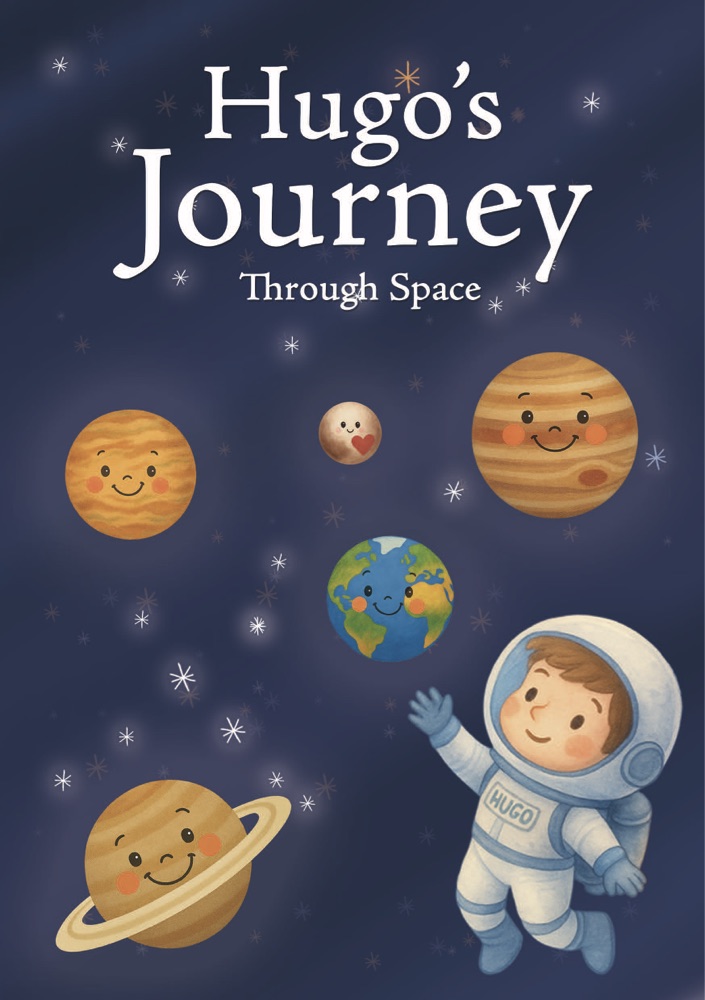
The picture book
Hugo's Journey Through Space
Onward Hugo flies, past wonders in the skies,
With a spark in his heart and wide, dreaming eyes.
Join Hugo on a magical adventure as he dreams his way through the solar system. From the warmth of the Sun to the icy edge of space, each stop along the journey is filled with wonder and discovery.
With gentle rhymes and charming illustrations, Hugo's Journey Through Space is a bedtime story for curious young explorers who love stars, planets and dreams that reach far beyond the night sky. Hugo meets every planet and every dwarf planet, from Mercury all the way out to Eris, each with its own story to share.
Coming soon to Amazon as an ebook, a paperback and a hardback. ISBN 978-1-0369-2940-4.
Fly the journey onlineThe first edition was a limited run of thirty copies. A new print edition is being prepared. Every planet, dwarf planet and moon from the book can be visited for free in the online journey.
Who Hugo meets
The Sun, then Mercury, Venus, Earth and the Moon, Mars with Phobos and Deimos, the dwarf planet Ceres, Jupiter and its four great moons, Saturn and Titan, sideways-spinning Uranus, windy Neptune and Triton, Pluto with its big heart and Charon, oval Haumea with Hi'iaka and Namaka, reddish Makemake, and icy Eris far beyond the comets. Then, with a yawn and a sigh, home to bed.
Space facts for dreamers
The facts from the back of the book, checked against NASA in September 2026.
- The Sun is so big you could fit more than a million Earths inside it.
- Jupiter is the largest planet in our solar system; it is more than eleven times wider than Earth.
- Saturn's rings are made of ice, rock and dust. Some pieces are as small as a grain of sand, a few as big as a house.
- A day on Venus is longer than a year on Venus.
- Neptune's winds are the fastest in the solar system, blowing faster than a jet plane.
- Mars has the tallest volcano in the solar system, Olympus Mons, which is nearly three times taller than Mount Everest.
- Pluto is smaller than our Moon, but it still has five moons of its own.
- The footprints left by astronauts on the Moon will stay there for millions of years because there is no wind or rain to wash them away.
- Stars are giant balls of burning gas. The closest star to Earth is the Sun.
- Voyager 1, a little spacecraft launched in 1977, flew out of the Sun's bubble into the space between the stars in 2012. It is farther than anything people have ever built, and still a long way from the very edge of the Sun's family.
For teachers and grown-ups
The online journey is free, has no adverts, no accounts and no tracking, and works on a whiteboard, a laptop or a tablet. Every moon count in it is dated and sourced to NASA and JPL. Curriculum-mapped resources for Year 5 Earth and Space are in preparation.