 Hugo's Solar System
Home › Explore › The Oort Cloud
Region
The Oort Cloud
A giant bubble of icy comets held by the Sun's gravity at the very edge of its family, where Hugo's journey ends
Key facts
- Where it is
- A shell around the whole solar system, from about 2,000 to 100,000 AU from the Sun
- Shape
- A sphere, like a bubble around the Sun, not a flat ring
- How far
- Its outer edge may lie halfway to the nearest star, Proxima Centauri
- How many
- Possibly trillions of icy bodies, with a total mass of a few Earths
- Named after
- Jan Oort, who proposed it in 1950 to explain long-period comets
- Seen directly?
- No. Its existence is inferred from the paths of comets
- Time to reach it
- Voyager 1 would need about 300 years to reach the inner edge and 30,000 years to cross it
- Possible member
- Sedna, a distant world found in 2003 that never comes closer than 76 AU
- What it gives us
- Long-period comets such as Hale-Bopp, which take thousands of years to orbit the Sun
About The Oort Cloud
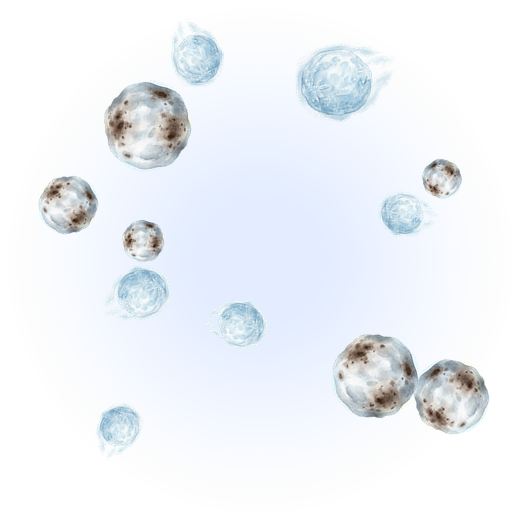
All the way at the edge, further than Hugo can fly, there may be a giant bubble made of billions of icy snowballs. We call it the Oort cloud. It is so far away that even the fastest spacecraft would take hundreds of years to reach it. Some of the snowballs fall towards the Sun and become comets with long shining tails. The Sun's gravity still holds every one of them, so this is the true edge of the Sun's family, and it is where Hugo's journey ends.
The Oort cloud is a huge shell of icy bodies that astronomers think surrounds the whole solar system, starting about 2,000 times as far from the Sun as Earth and reaching perhaps 100,000 times as far. Unlike the belts, it is shaped like a bubble, not a ring. Nobody has ever seen it directly, but long-period comets, the ones that take thousands of years to come round, seem to fall in from that direction. Voyager 1, the most distant spacecraft, would need about 300 years to reach the cloud's inner edge and 30,000 years to pass through it.
The Oort cloud is a theoretical spherical reservoir of icy planetesimals proposed by Jan Oort in 1950 to explain the orbits of long-period comets. Its inner edge is placed at roughly 2,000 to 5,000 AU and its outer edge at 10,000 to 100,000 AU, perhaps halfway to the nearest star, and it may hold trillions of bodies with a combined mass of a few Earths. The objects are thought to have formed nearer the giant planets and been scattered outward, then rounded into a shell by the tides of the Milky Way and passing stars. Passing stars can also nudge bodies inward as new comets.
Sedna, discovered in 2003, may belong to an inner Oort cloud. Voyager 1, at about 172 AU in 2026, would reach the inner edge in around 300 years.
Did you know?
- Light from the Sun takes about eight minutes to reach Earth but more than a week to reach the middle of the Oort cloud.
- A passing star can jolt Oort cloud snowballs loose and send new comets falling towards the Sun.
- Voyager 1 left the Sun's bubble of solar wind in 2012, yet it is still thousands of times closer to the Sun than the Oort cloud.
- The Sun's gravity still holds the Oort cloud, so the solar system is about a thousand times wider than the orbit of Voyager 1.
Questions children ask
Have the Voyagers reached the Oort cloud?
No, not nearly. Voyager 1 is about 172 AU from the Sun; the cloud's inner edge is thought to start at about 2,000 AU. NASA estimates Voyager would take about 300 years to reach it.
If nobody has seen it, how do we know it is there?
Long-period comets arrive from every direction in the sky, not just along the flat plane of the planets, and their orbits stretch out to tens of thousands of AU. A spherical cloud of icy bodies at that distance is the simplest explanation.
Is the Oort cloud the edge of the solar system?
It is the outermost part. The Sun's gravity still holds the cloud, so the solar system reaches far beyond the planets and beyond the Voyagers.
What is it made of?
Icy bodies, mostly water ice with frozen methane, ammonia and carbon monoxide, probably mixed with dust and rock, much like comet nuclei.
Quick quiz
Three questions for space cadets. Nothing is recorded.
- What shape is the Oort cloud?
- Has a spacecraft reached the Oort cloud?
- What comes to us from the Oort cloud?
 Voyager 1
 Eris
Eris The Kuiper Belt