 Hugo's Solar System
Home › Explore › The Heliopause
Region
The Heliopause
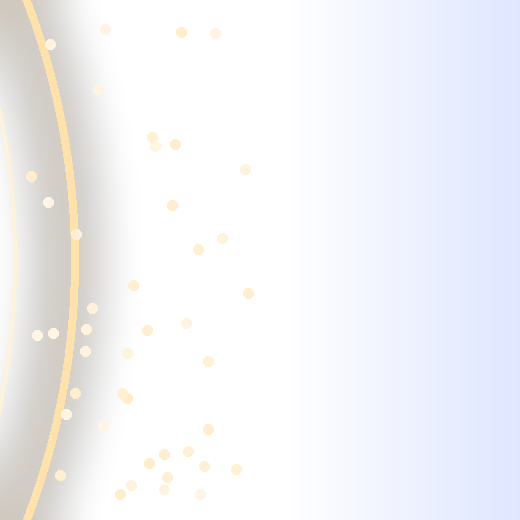
The edge of the Sun's bubble, where the solar wind stops and interstellar space begins
Key facts
- Where it is
- About 120 AU from the Sun, roughly 11.2 billion miles / 18 billion km
- What it is
- The boundary where the solar wind stops and the interstellar medium begins
- Shape
- A bubble around the whole solar system, squashed on the side that faces the Sun's motion through the galaxy
- Termination shock
- Nearer in, about 90 AU, where the solar wind slows below the speed of sound
- Voyager 1 crossed
- 25 August 2012, at about 121 AU
- Voyager 2 crossed
- 5 November 2018, at about 119 AU
- What changes
- Solar particles drop away, galactic cosmic rays rise, and the plasma becomes denser and cooler
- Time for light
- Sunlight takes about 17 hours to reach the heliopause
- Beyond it
- The Sun's gravity still rules; the Oort cloud lies far outside the heliopause
About The Heliopause
The Sun blows a wind of tiny bits out into space, and it makes a huge bubble around all the planets. Very far out, the wind gets tired and stops. That edge is called the heliopause. Two robot spacecraft called Voyager 1 and Voyager 2 have flown right through it.
The Sun streams out a wind of charged particles in every direction, blowing a giant bubble called the heliosphere around the planets. About 120 times farther from the Sun than Earth, the solar wind runs out of push against the thin gas between the stars. That boundary is the heliopause. Voyager 1 crossed it on 25 August 2012 and Voyager 2 on 5 November 2018, and both found the space beyond to be denser and cooler, with the Sun's magnetic field left behind.
The heliosphere is the region dominated by the solar wind's plasma and magnetic field. Its outer boundary, the heliopause, is where the solar wind's outward pressure balances the pressure of the local interstellar medium; it lies at roughly 120 AU, though it flexes with the solar cycle. Inside it the wind first drops to subsonic speed at the termination shock, near 90 AU. Voyager 1 crossed the heliopause at about 121 AU on 25 August 2012, and Voyager 2 at about 119 AU on 5 November 2018, measuring a sharp rise in plasma density and a fall in solar particles. The heliopause is often called the edge of the solar system, but the Sun's gravity dominates far beyond it, out through the Oort cloud.
Did you know?
- The heliopause moves in and out over the Sun's 11-year activity cycle, so Voyager 2 crossed it closer in than Voyager 1 did.
- Radio signals from Voyager 1 now take more than 23 hours to reach Earth from beyond the heliopause.
- Leaving the heliosphere is not the same as leaving the solar system: the Sun's gravity reaches a thousand times farther.
Questions children ask
Is the heliopause the edge of the solar system?
It is the edge of the Sun's wind, and the start of interstellar space. But the solar system, defined by the Sun's gravity, continues out through the Oort cloud, perhaps 100,000 AU away.
Can you see the heliopause?
No. It is a change in thin, invisible plasma. Spacecraft detect it by measuring particles and magnetic fields, and NASA's IBEX mission maps the boundary from Earth orbit using neutral atoms that come from it.
Why does the solar wind stop?
The farther out it goes, the more it spreads and weakens, until the pressure of the interstellar gas outside matches it. Where the two balance, the wind can push no farther.
Quick quiz
Three questions for space cadets. Nothing is recorded.
- What stops at the heliopause?
- Which spacecraft crossed the heliopause first?
- About how far away is the heliopause?
 Voyager 1
 Voyager 2
 Eris
Eris