 Hugo's Solar System
Home › Explore › Earth › The Moon
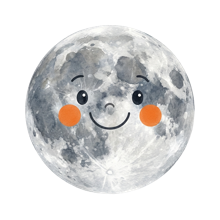
Moon of Earth
The Moon
Earth's only natural satellite, and the only other world people have walked on
You spin on a tilt with a Moon by your side,
With weather and seasons and creatures worldwide.From Hugo's Journey Through Space
Key facts
- Diameter
- About 2,160 miles / 3,474 km (just over a quarter of Earth's)
- Distance from Earth
- 239,000 miles / 384,400 km on average
- One orbit
- 27.3 days (29.5 days from one new moon to the next)
- One day (rotation)
- 27.3 days, the same as its orbit, so one side always faces Earth
- Surface gravity
- About one sixth of Earth's
- Surface temperature
- About 127 °C in sunlight, about −173 °C in darkness
- Age
- About 4.5 billion years
- Discovered
- Known since ancient times
- Named after
- Not named after anyone; 'Moon' is simply the old English word for it, and its Latin name is Luna
- Surface
- Grey, dusty rock covered in craters; Tycho Crater is more than 52.8 miles / 85 km wide
- Visited by
- Luna 1 (1959), Luna 9 (1966), Apollo 11 to 17 (1969 to 1972), Lunar Reconnaissance Orbiter (2009), GRAIL (2012), Artemis I (2022), Artemis II (2026) and more than 105 robotic spacecraft
About The Moon
The Moon is Earth's friend in the sky. It goes round and round our planet. The Moon is smaller than Earth. It is grey and rocky. It has no air to breathe. It has no wind and no rain. You can see holes on the Moon. These holes are called craters. Space rocks made them long ago. The Moon seems to change shape. It goes from thin to round and back. Twelve people have walked on the Moon. They left footprints in the dust. The footprints are still there today. Look up tonight and wave to it.
The Moon is Earth's only natural satellite and our closest neighbour in space. It is about 3,474 km across, roughly a quarter of Earth's width. On average it sits about 384,400 km away from us. The Moon takes about 27 days to orbit Earth once.
It also takes about 27 days to rotate once on its axis. Because both take the same time, we always see the same side. The far side stayed hidden until spacecraft photographed it. The Moon's gravity is only about one sixth as strong as Earth's.
An astronaut there could jump much higher than at home. The Moon has almost no atmosphere, so the sky is black even by day. Without air, temperatures swing from 127 °C in sunlight to −173 °C in darkness. Its surface is covered in craters made by crashing space rocks.
Scientists think the Moon formed about 4.5 billion years ago. A Mars-sized object hit the young Earth and threw out material. That material gathered together to make the Moon. Between 1969 and 1972, twelve astronauts walked on the Moon.
In April 2026, four astronauts flew around it on Artemis II. The Moon is slowly drifting away from us, about 3.8 cm each year.
The Moon is Earth's only natural satellite. Its mean radius is 1,737.4 km (JPL Solar System Dynamics), giving a diameter of about 3,474 km, roughly 27% of Earth's. It orbits at an average distance of 384,400 km, varying between about 362,600 km at perigee and 405,400 km at apogee. The sidereal orbital period is 27.32 days; the cycle of phases, which also depends on the Sun's position, takes 29.53 days. The Moon rotates once per orbit, so the same hemisphere always faces Earth. This tidal locking is often misdescribed as the Moon 'not rotating'; it does rotate, at exactly the rate it orbits.
Surface gravity is about one sixth of Earth's (1.62 m/s²). The Moon has only a tenuous exosphere, so temperatures swing from about 127 °C in sunlight to about −173 °C in shadow. Water ice survives in permanently shadowed polar craters, and water molecules have been detected even on the sunlit surface. The interior comprises a crust (about 40 km thick on the near side, up to 60 km on the far side), a mantle, and a small core about 240 km in radius wrapped in a 90 km layer of liquid iron.
The leading formation model is a giant impact about 4.5 billion years ago, when a Mars-sized body, usually called Theia, struck the young Earth; the ejected debris coalesced into the Moon within roughly 60 million years of the solar system's birth. The Moon is receding from Earth by about 3.8 cm per year.
Exploration began with the Soviet Luna 1 flyby in 1959 and Luna 9's first soft landing in 1966. Apollo 11 landed Neil Armstrong and Buzz Aldrin on 20 July 1969, and across the Apollo landings of 1969 to 1972 twelve astronauts walked on the surface and returned 382 kg of samples. Later missions include Clementine, Lunar Prospector, the Lunar Reconnaissance Orbiter and LCROSS (2009) and GRAIL (2012); more than 105 robotic spacecraft have been launched towards the Moon, and the USSR, United States, China and India have all landed there. Artemis I flew uncrewed in November 2022. Artemis II (1 to 10 April 2026) carried Reid Wiseman, Victor Glover, Christina Koch and Canada's Jeremy Hansen around the far side, reaching a record 406,771 km from Earth.
Did you know?
- The Moon drifts about 3.8 cm further away from Earth every year, so it was closer when the dinosaurs looked up at it.
- Apollo astronauts brought home 382 kg of Moon rocks and soil, and scientists are still studying those samples today.
- In April 2026 the Artemis II crew travelled 406,771 km from Earth, further than any humans had ever been before.
Neighbours around Earth
The Moon is the only known moon of Earth.
Questions children ask
Why does the Moon change shape?
The Moon does not really change shape. It is always a ball, but the Sun lights up only half of it. As the Moon orbits Earth over about 29.5 days, we see different amounts of the lit half, from a thin crescent to a full round Moon and back.
Why do we always see the same side of the Moon?
The Moon rotates once in exactly the time it takes to orbit Earth, about 27 days. This is called tidal locking. Because of it, the same face always points towards us. The far side is not dark; it gets just as much sunlight, we simply cannot see it from Earth.
Is there water on the Moon?
Yes, but not as rivers or lakes. Ancient ice sits in deep craters near the poles that never see sunlight, and tiny amounts of water have been found even on the sunlit surface. Future astronauts may be able to use this ice for drinking water and rocket fuel.
How many people have walked on the Moon?
Twelve people have walked on the Moon, all American astronauts on the Apollo missions between 1969 and 1972. Neil Armstrong and Buzz Aldrin were the first, on 20 July 1969. In April 2026, four astronauts on Artemis II flew around the Moon but did not land.
Quick quiz
Three questions for space cadets. Nothing is recorded.
- About how long does the Moon take to orbit Earth once?
- How strong is gravity on the Moon compared with Earth?
- What made most of the craters on the Moon?
Where next?
 Earth
Earth Ganymede
 Charon
Sources
- https://science.nasa.gov/moon/facts/
- https://science.nasa.gov/moon/
- https://science.nasa.gov/moon/exploration/
- https://science.nasa.gov/moon/formation/
- https://www.nasa.gov/mission/artemis-ii/
- https://www.nasa.gov/mission/apollo-11/
- https://ssd.jpl.nasa.gov/sats/phys_par/
- https://en.wikipedia.org/wiki/Moon
- https://en.wikipedia.org/wiki/Artemis_II