 Hugo's Solar System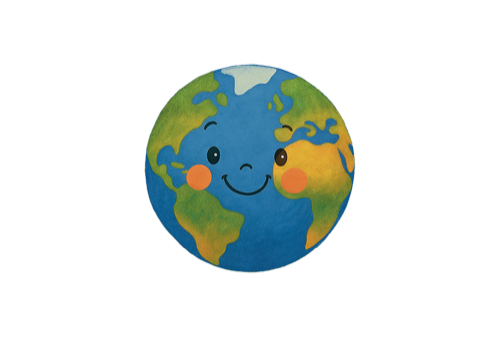
Planet
Earth
Our blue home, the only world we know that is alive
"Ah, home," giggles Hugo, "so blue and so green.
With oceans that sparkle and forests between."From Hugo's Journey Through Space
Key facts
- Diameter
- 7,930 miles / 12,756 km at the equator
- Distance from the Sun
- 1 AU (about 93 million miles / 149.6 million km)
- One orbit
- 365.25 Earth days
- One day (rotation)
- 23.9 hours (23 hours 56 minutes)
- Average temperature
- About 15°C
- Known moons
- 1 (as of September 2026)
- Named after
- The Old English word eorðe, meaning ground; the only planet not named after a god
- Discovered
- Known since ancient times
- Visited by
- Studied from orbit by Landsat (since 1972), Terra, Aqua, ICESat-2, SWOT, PACE, Sentinel-6 and the ISS; photographed whole by Apollo 17
- Axial tilt
- 23.4 degrees
- Ocean cover
- About 71 per cent of the surface
- Age
- About 4.5 billion years
About Earth
Earth is our home. It is a big blue ball. Most of Earth is covered by sea. That is why it looks blue. The land is green and brown. White clouds float above it all. Earth spins round once each day. That gives us day and night. Earth goes round the Sun once a year. Earth has one moon. The Moon shines at night. Our air is just right to breathe. Earth is the only world we know with life. You live on Earth. So do all the plants and animals. Look up and wave to space.
Earth is the third planet from the Sun and our home. It is a rocky sphere about 12,756 km wide at the equator. Earth travels around the Sun on an orbit that takes 365.25 days. That extra quarter day is why we add a leap day every four years.
The planet also rotates on its axis once every 23.9 hours. Earth's axis is tilted by 23.4 degrees, which gives us the seasons. Water covers about 71 per cent of the surface, so Earth looks blue. The atmosphere is mostly nitrogen and oxygen, with a little of other gases.
It keeps us warm and protects us from harmful rays. Deep inside are a hot metal core, a thick mantle and a thin crust. The moving outer core makes a magnetic field that shields the planet. Earth has one moon, as of August 2026, and it is quite large.
The Moon is about 384,400 km away and its pull makes our tides. Earth's gravity holds the air, the sea and you firmly in place. As far as we know, Earth is the only planet with life.
Earth is the third planet from the Sun and the largest of the four rocky, terrestrial planets. Its equatorial diameter is 12,756 km and its mean radius 6,371 km; rotation makes it bulge slightly at the equator, so it is an oblate spheroid rather than a perfect sphere. Earth orbits at an average distance of about 149.6 million km, the distance that defines one astronomical unit (AU), and sunlight takes about 8.3 minutes to reach us. One orbit takes 365.25 days, which is why a leap day is added every four years.
The length of a day is often misstated. Earth rotates once relative to the stars in 23 hours 56 minutes (the sidereal day), but because it also moves along its orbit, the Sun returns to the same position only after 24 hours (the solar day). The axis is tilted 23.4 degrees to the orbital plane, and it is this tilt, not a changing distance from the Sun, that causes the seasons: Earth is actually closest to the Sun in early January, during the northern winter.
The atmosphere is 78 per cent nitrogen, 21 per cent oxygen and 1 per cent other gases, including the carbon dioxide and water vapour whose greenhouse effect keeps the mean surface temperature at about 15°C. Oceans cover about 71 per cent of the surface, with an average depth of about 3.6 km. Beneath a crust roughly 30 km thick on land and 5 km under the oceans lie a mantle about 2,900 km thick, a liquid outer core and a solid inner core with a radius of 1,221 km and temperatures up to about 5,400°C. Convection in the liquid iron of the outer core generates the magnetic field that deflects much of the solar wind. Earth formed about 4.5 billion years ago and has one natural satellite, the Moon, at an average distance of 384,400 km.
Earth is studied from orbit more intensively than any other body. The Apollo missions returned the first whole-Earth portraits, including Apollo 17's 'Blue Marble' photograph of December 1972. Landsat 1, launched on 23 July 1972, began the longest continuous record of Earth's land surface, continued today by Landsat 8 and 9. NASA's Earth Science Division now operates more than 20 satellites, among them Terra, Aqua, ICESat-2, SWOT, PACE and Sentinel-6 Michael Freilich, while the International Space Station carries its own Earth-observing instruments.
Did you know?
- Earth is the only planet not named after a Greek or Roman god. Its name comes from an Old English word simply meaning the ground.
- Earth's inner core reaches about 5,400°C, roughly as hot as the surface of the Sun, yet it stays solid because of the enormous pressure.
- The deepest point in the ocean, the Challenger Deep, is nearly 11 km down, deeper than Mount Everest is tall at 8,849 m.
Moons of Earth
Earth has 1 known moon as of September 2026. Here it is. How many moons does Earth have?
Questions children ask
Why does Earth look blue from space?
Oceans cover about 71 per cent of Earth's surface, and water reflects and scatters blue light much more than red. Add the blue sky of our atmosphere and the planet glows blue, with green and brown land and swirls of white cloud on top.
Why do we have seasons?
Not because Earth gets nearer the Sun. Earth's axis is tilted by 23.4 degrees, so as it orbits, one half of the planet leans towards the Sun and gets longer, warmer days while the other half leans away. Earth is actually closest to the Sun in early January.
How old is Earth?
Earth formed about 4.5 billion years ago from the cloud of gas and dust that made the Sun and the other planets. Scientists work this out by measuring the slow decay of radioactive elements in the oldest rocks and meteorites.
Is Earth a perfect ball?
Almost, but not quite. Earth is a sphere that bulges slightly at the equator because it spins, so it is a little wider across the middle than from pole to pole. Mountains and ocean trenches are tiny bumps compared with the whole planet.
Quick quiz
Three questions for space cadets. Nothing is recorded.
- How long does Earth take to travel once around the Sun?
- What covers about 71 per cent of Earth's surface?
- Which gas makes up most of Earth's atmosphere?
 Mars
Mars Venus
Venus The Moon