 Hugo's Solar System
Home › Explore › Mars › Phobos
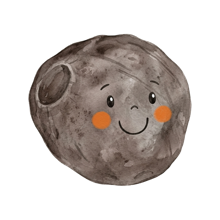
Moon of Mars
Phobos
The dark, potato-shaped moon that races round Mars three times a day
Key facts
- Diameter
- About 27 by 22 by 11.2 miles / 18 km (mean radius 11.08 km)
- Distance from Mars
- About 5,830 miles / 9,376 km from the centre of Mars, roughly 6,000 km above the surface
- One orbit
- 7 hours 39 minutes (about three orbits a day)
- One day (rotation)
- Tidally locked, so the same as its orbit: 7 hours 39 minutes
- Discovered
- 17 August 1877 by Asaph Hall, United States Naval Observatory
- Named after
- Phobos, meaning fear, a son of Ares in Greek mythology
- Surface
- Very dark C-type rock, powdery dust, Stickney crater (about 5.6 miles / 9 km wide) and long grooves
- Density
- About 1.87 g/cm3
- Surface temperature
- About -4 °C to -112 °C
- Visited by
- Mariner 7 and 9, Viking 1, Phobos 2, Mars Global Surveyor, Mars Express, Mars Reconnaissance Orbiter; MMX planned
- Future
- Falling about 1.8 m closer to Mars every 100 years; will break up or crash in about 50 million years
About Phobos
Phobos is a moon of Mars. It is small and lumpy. It looks like a potato. Phobos is very close to Mars. It zooms round Mars three times a day. It rises in the west. It sets in the east. Phobos has a giant hole. The hole is called Stickney. Long grooves run across its surface. Phobos is as dark as coal. It is slowly falling towards Mars. One day it may break into a ring. But that is millions of years away. Its name means fear. You would weigh almost nothing there.
Phobos is the larger of the two moons of Mars. It is not a sphere like our Moon. Instead it is a lumpy shape about 27 kilometres long. Phobos is one of the closest moons to its planet anywhere.
It orbits only about 6,000 kilometres above the surface of Mars. Because it is so close, Phobos moves very quickly. One orbit takes just 7 hours and 39 minutes. That means Phobos travels round Mars three times every day.
Seen from Mars, Phobos rises in the west and sets in the east. Phobos is very dark, like a lump of coal. Its biggest crater is called Stickney and is about 9 kilometres wide. Long grooves stretch across the surface, and nobody is quite sure how they formed.
The gravity on Phobos is tiny because the moon is so small. If you jumped hard, you could launch yourself into space. Phobos is slowly falling towards Mars by about 1.8 metres every hundred years. In about 50 million years it will break apart or crash.
Asaph Hall discovered Phobos in 1877 using a big telescope. Its name comes from the Greek word for fear.
Phobos is the larger and inner of Mars's two known moons (as of August 2026). It is far from spherical: NASA gives its dimensions as about 27 by 22 by 18 km, with a mean radius of 11.08 km according to JPL Solar System Dynamics. It orbits at a semi-major axis of about 9,376 km from the centre of Mars, roughly 6,000 km above the surface, closer to its planet than any other known moon in the solar system. One orbit takes 7 hours 39 minutes, faster than Mars rotates, so from the Martian surface Phobos rises in the west and sets in the east, crossing the sky in about four hours or less. It is tidally locked, always showing Mars the same face.
The surface is very dark, reflecting only about 7 per cent of sunlight, and its spectrum resembles carbonaceous (C-type) asteroids. Its mean density is low, about 1.87 g/cm3, suggesting a porous, rubble-pile interior or some ice. Whether Phobos is a captured asteroid or debris from a giant impact on Mars remains an open question that sample return is intended to settle. The dominant feature is Stickney crater, roughly 9 km across, and the surface is scored by parallel grooves up to 20 km long. Measured surface temperatures range from about -4 °C to -112 °C.
Asaph Hall discovered Phobos at the United States Naval Observatory in August 1877 (NASA gives 17 August; some sources give 18 August, a difference of time zone). The name, meaning fear, comes from a son of Ares in Greek mythology and was suggested by Henry Madan of Eton College.
Phobos has been imaged by Mariner 7 and Mariner 9, Viking 1, the Soviet Phobos 2 orbiter, Mars Global Surveyor, ESA's Mars Express and NASA's Mars Reconnaissance Orbiter, and photographed from the ground by NASA's rovers. JAXA's Martian Moons eXploration (MMX) mission, scheduled to launch in October 2026, aims to land on Phobos and return samples to Earth in 2031.
A common misconception is that Phobos is stable. Tidal forces are lowering its orbit by about 1.8 metres per century; within roughly 50 million years it will either break up into a ring around Mars or hit the planet. It is also often assumed all moons are round; Phobos, like most small moons, is not.
Did you know?
- Phobos orbits faster than Mars spins, so on Mars it rises in the west and sets in the east, crossing the sky in about four hours.
- Stickney crater is about 9 km wide, so big that the impact which made it nearly shattered the whole moon.
- Phobos creeps about 1.8 metres closer to Mars every century and will one day break apart into a ring around the planet.
Neighbours around Mars
Questions children ask
Why is Phobos not round like our Moon?
Phobos is tiny, only about 27 km at its longest. Its gravity is far too weak to pull it into a sphere. Only big moons and planets have enough gravity to squash themselves into balls, so Phobos keeps its lumpy potato shape.
Will Phobos really crash into Mars?
Yes, eventually. Tides from Mars pull Phobos about 1.8 metres lower every hundred years. In roughly 50 million years it will get so close that it either breaks into a ring or hits the surface. No one alive will see it happen.
Where did Phobos come from?
Scientists are not sure. It looks like a dark C-type asteroid, so it may have been captured by Mars. But its orbit is so neat and circular that it may instead be debris from a giant impact on Mars. JAXA's MMX mission aims to bring back samples to find out.
Could a person jump off Phobos?
Almost. Phobos is so small that its surface gravity is less than a thousandth of Earth's. A strong jump would carry you a very long way, and a fast run or a thrown ball could leave the moon entirely.
Quick quiz
Three questions for space cadets. Nothing is recorded.
- How long does Phobos take to orbit Mars once?
- Who discovered Phobos in 1877?
- What is the name of the giant crater on Phobos?
 Deimos
 The Moon
 Mars
Mars