 Hugo's Solar System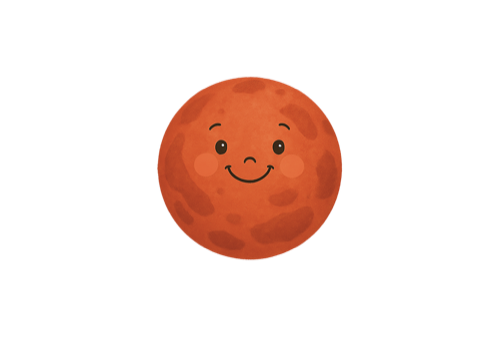
Planet
Mars
The rusty red planet with the tallest volcano and two tiny lumpy moons
"Red planet, reporting," cries Mars loud and clear.
"My deserts are dusty, my skies have no cheer."From Hugo's Journey Through Space
Key facts
- Diameter
- About 4,210 miles / 6,779 km, roughly half the width of Earth
- Distance from the Sun
- 1.5 AU (about 142 million miles / 228 million km)
- One orbit
- 687 Earth days (about 1.88 Earth years)
- One day (rotation)
- 24.6 hours
- Average temperature
- About -60°C (from about 20°C down to -153°C)
- Known moons
- 2 (as of September 2026)
- Named after
- The Roman god of war
- Discovered
- Known since ancient times
- Tallest volcano
- Olympus Mons, the tallest in the solar system; NASA gives its height as more than 24.9 miles / 40 km from base to summit
- Longest canyon
- Valles Marineris, about 2,400 miles / 3,870 km long and up to 9.3 km deep
- Visited by
- Mariner 4 (1965), Viking 1 and 2 (1976), Pathfinder (1997), Spirit and Opportunity (2004), Curiosity (2012), Perseverance and Ingenuity (2021) and many orbiters
About Mars
Mars is the fourth planet from the Sun. It is red like rust. That is because its rocks have iron in them. Mars is a cold, dry desert. It is about half the size of Earth. Mars has two tiny moons. Their names are Phobos and Deimos. They look like lumpy potatoes. Mars has the biggest volcano we know. It is called Olympus Mons. Robots drive around on Mars today. They take photos and dig in the dust. One day, people may visit Mars too. Would you like to go?
Mars is the fourth planet from the Sun and the seventh largest. It orbits about 228 million km from the Sun, which is 1.5 times as far as Earth. One trip around the Sun takes Mars 687 Earth days. Mars rotates once every 24.6 hours, so a day there is much like ours.
Its axis is tilted by 25 degrees, which gives Mars seasons just like Earth. Mars is a sphere about 6,779 km across, roughly half the width of Earth. Gravity there is weaker, so you could jump nearly three times higher. The atmosphere is very thin and made mostly of carbon dioxide.
That means the air is far too thin to breathe. Mars is cold, with an average temperature of about minus 60 degrees Celsius. The red colour comes from iron oxide, which is the same stuff as rust. Mars has the tallest volcano in the solar system, called Olympus Mons.
It also has a huge canyon, Valles Marineris, about 3,870 km long. Mars has two small moons, Phobos and Deimos, as of August 2026. Robot rovers such as Curiosity and Perseverance explore the surface right now. They are searching for signs that Mars once had rivers and lakes.
Mars is the fourth planet from the Sun and the outermost of the rocky planets. Its mean radius is 3,389.5 km, giving a diameter of about 6,779 km, roughly half Earth's. It orbits at an average of 228 million km (1.5 AU), taking 687 Earth days (669.6 sols) to complete one orbit, and rotates once every 24.6 hours. Its axial tilt of 25 degrees, close to Earth's 23.4 degrees, produces seasons, though the eccentric orbit makes them unequal in length. Surface gravity is 3.71 m/s², about 38% of Earth's.
The atmosphere is thin, with a surface pressure less than 1% of Earth's, and is roughly 96% carbon dioxide with small amounts of argon and nitrogen. Temperatures range from about 20°C on a summer afternoon to minus 153°C at the poles, with a mean of about minus 60°C. The red colour is iron oxide in the surface dust. Mars has no global magnetic field today, although magnetised crust in the southern hemisphere records one from about 4 billion years ago. Olympus Mons is the largest volcano in the solar system; NASA gives its height as more than 40 km above its base, while other sources quote about 22 km above the mean surface. Valles Marineris runs about 3,870 km long and up to 9.3 km deep. Both polar caps hold water ice, and valleys and deltas show that liquid water flowed about 3.5 billion years ago.
Mars has two small moons, Phobos and Deimos, discovered by Asaph Hall in August 1877 (as of August 2026). Phobos is spiralling inward and will crash or break apart in about 50 million years.
Mariner 4 made the first successful flyby in July 1965, Mariner 9 became the first orbiter in 1971, and Viking 1 and 2 landed in 1976. Pathfinder and Sojourner followed in 1997, then Spirit and Opportunity (2004), Phoenix (2008), Curiosity (2012), InSight (2018) and Perseverance (2021). The Ingenuity helicopter made 72 flights between April 2021 and January 2024. Orbiters at Mars include Mars Odyssey, Mars Express, Mars Reconnaissance Orbiter, the ExoMars Trace Gas Orbiter, the UAE's Hope and China's Tianwen-1; NASA's MAVEN orbiter fell silent on 6 December 2025 and its mission was declared over on 3 June 2026. A common misconception is that Mars is warm because it is red; it is a cold desert.
Did you know?
- Sunlight takes about 13 minutes to travel from the Sun to Mars, so you would see the Sun as it was 13 minutes ago.
- Phobos orbits Mars three times a day and is slowly falling inward. In about 50 million years it will crash or break into a ring.
- The Ingenuity helicopter was built to try five flights, but it flew 72 times, the first aircraft ever to fly on another planet.
Moons of Mars
Mars has 2 known moons as of September 2026. The largest are listed here. How many moons does Mars have?
Questions children ask
Why is Mars red?
The rocks and dust on Mars contain a lot of iron. Over billions of years the iron has reacted to form iron oxide, which is the same thing as rust. That rusty dust covers the whole planet and gives Mars its orange-red colour.
Could I breathe on Mars?
No. The air on Mars is very thin, with less than 1% of the pressure of Earth's air, and it is almost all carbon dioxide. Astronauts would need a spacesuit with its own oxygen supply to walk on the surface.
Has anyone been to Mars?
No people have gone yet, but many robots have. The first spacecraft to fly past was Mariner 4 in 1965. Viking 1 and 2 landed in 1976, and rovers such as Curiosity and Perseverance are driving across the surface today.
How long is a day on Mars?
Mars rotates once every 24.6 hours, so a Martian day, called a sol, is only about 40 minutes longer than a day on Earth. A Martian year is much longer though, at 687 Earth days, because Mars is farther from the Sun.
Quick quiz
Three questions for space cadets. Nothing is recorded.
- How many moons does Mars have, as of August 2026?
- What gives Mars its red colour?
- How long does Mars take to orbit the Sun once?
Where next?
 Earth
Earth Phobos
 Deimos
Sources
- https://science.nasa.gov/mars/facts/
- https://science.nasa.gov/mars/moons/
- https://science.nasa.gov/mars/
- https://science.nasa.gov/mission/mars-2020-perseverance/ingenuity-mars-helicopter/
- https://ssd.jpl.nasa.gov/planets/phys_par.html
- https://www.esa.int/Science_Exploration/Space_Science/Mars_Express
- https://en.wikipedia.org/wiki/Mars
- https://en.wikipedia.org/wiki/Exploration_of_Mars