 Hugo's Solar System
Home › Explore › Saturn › Titan
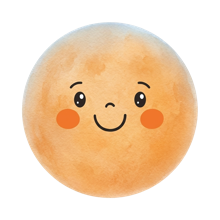
Moon of Saturn
Titan
Saturn's giant moon, where orange skies rain methane into cold seas
Hugo spins through the rings with a joyful "Wheee!"
Then glides past Titan as cool as can be.From Hugo's Journey Through Space
Key facts
- Diameter
- About 3,200 miles / 5,150 km (radius about 2,575 km), larger than Mercury
- Distance from Saturn
- About 0.75 million miles / 1.2 million km
- One orbit
- 15 days and 22 hours (about 15.9 Earth days)
- One day (rotation)
- Tidally locked, so the same as its orbit
- Discovered
- 25 March 1655 by Christiaan Huygens
- Named after
- The Titans of Greek mythology; name proposed by John Herschel in 1847
- Atmosphere
- About 95% nitrogen and 5% methane, surface pressure about 60% higher than Earth's
- Surface temperature
- About -179 °C
- Surface
- Water ice, hydrocarbon dunes, and lakes and seas of liquid methane and ethane
- Subsurface ocean
- Liquid water thought to lie 34.2 to 49.7 miles / 55 to 80 km below the surface
- Visited by
- Pioneer 11 (1979), Voyager 1 (1980), Cassini (2004 to 2017), Huygens landing (14 January 2005); Dragonfly due to launch in 2028
About Titan
Titan is Saturn's biggest moon. It is bigger than the planet Mercury. Thick orange clouds hide its ground. The air on Titan is very thick. Rain falls there, but not water rain. The rain is made of cold methane. It fills lakes and seas. The seas are near the top and bottom. Titan is very, very cold. Ice there is as hard as rock. A tiny probe called Huygens landed there. It sent back photos of round pebbles. One day a flying robot will visit. Its name is Dragonfly. Would you like to fly there?
Titan is Saturn's largest moon and the second largest in the solar system. Its radius is about 2,575 kilometres, which makes it wider than the planet Mercury. It orbits Saturn about 1.2 million kilometres out, taking 15 days and 22 hours. Titan always shows the same face to Saturn, just as our Moon does to Earth.
What makes Titan special is its thick, hazy atmosphere. The air is mostly nitrogen, like Earth's, with some methane mixed in. At the surface the air pushes down about 60 per cent harder than it does on Earth. Orange smog hides the ground, so cameras need radar to see through it.
It is bitterly cold, about minus 179 degrees Celsius. At that temperature methane behaves like water, so it falls as rain and collects in lakes. Titan is the only world apart from Earth with liquid on its surface. Deep below the icy crust, scientists think there is an ocean of salty water.
The Dutch astronomer Christiaan Huygens discovered Titan in 1655 using his own telescope. The Huygens probe landed there on 14 January 2005 and photographed a rocky orange plain. NASA's Dragonfly rotorcraft is due to launch in 2028 and fly across Titan's dunes.
Titan is Saturn's largest moon and the second largest in the solar system, with a mean radius of about 2,575 km. Only Jupiter's Ganymede is bigger, by roughly 2 per cent, and Titan is larger than the planet Mercury, though far less massive. It orbits Saturn at about 1.2 million km every 15 days and 22 hours, and is tidally locked, so one hemisphere always faces the planet. Christiaan Huygens discovered it on 25 March 1655; the name Titan was proposed by John Herschel in 1847, after the Titans of Greek mythology.
Titan is the only moon known to have a substantial atmosphere. It is about 95 per cent nitrogen and about 5 per cent methane, extends nearly 600 km above the surface, and produces a surface pressure roughly 60 per cent higher than Earth's at sea level. Sunlight breaking down methane creates a thick orange photochemical haze, which is why the surface is invisible in ordinary photographs. The surface temperature is about minus 179 degrees Celsius. At that temperature methane and ethane are liquids, and Titan has clouds, rain, rivers, lakes and seas of them, concentrated near the poles; it is the only place besides Earth with stable liquid on its surface. Equatorial regions are dominated by dunes of organic particles. Beneath a crust of water ice, gravity measurements point to a liquid water ocean some 55 to 80 km down.
Pioneer 11 passed through the Saturn system on 1 September 1979, and Voyager 1 made the first close flyby of Titan in 1980, finding only the haze. Cassini arrived at Saturn on 1 July 2004 and completed more than 100 targeted Titan flybys before ending its mission in September 2017, mapping the surface by radar and infrared. ESA's Huygens probe, carried by Cassini, descended by parachute for about two and a half hours and landed on 14 January 2005, transmitting from the surface for more than an hour. It remains the only landing on a moon other than our own. NASA's Dragonfly, a nuclear-powered rotorcraft, is scheduled to launch no earlier than July 2028 and reach Titan in 2034 for a mission of about three years, sampling the surface to study prebiotic chemistry. A common misconception is that Titan's seas are water; they are liquid hydrocarbons, and any water there is frozen as hard as rock.
Did you know?
- Titan is the only moon in the solar system with a thick atmosphere, and the only world besides Earth with lakes and seas on its surface.
- The Huygens probe took about two and a half hours to parachute down to Titan, then sent pictures from the surface for more than an hour.
- Sunlight at Titan is about 100 times fainter than at Earth, and it takes light about 80 minutes to get there from the Sun.
Neighbours around Saturn
Questions children ask
Could I breathe on Titan?
No. Titan's air is mostly nitrogen with methane and almost no oxygen, and it is about minus 179 degrees Celsius. You would need a spacesuit with its own air and a very good heater, but you would not need a pressure suit, because the air is thicker than Earth's.
Why is Titan orange?
Sunlight breaks up the methane high in Titan's atmosphere, and the pieces join together into a thick haze of orange organic particles. This smog is so dense that cameras cannot see the ground, so Cassini used radar to map the surface instead.
Is there water on Titan?
Yes, but it is frozen. Titan's crust is made of water ice as hard as rock, and scientists think a salty liquid water ocean lies 55 to 80 km underneath. The lakes on the surface are liquid methane and ethane, not water.
Has anything landed on Titan?
Yes. ESA's Huygens probe, carried there by NASA's Cassini spacecraft, landed on 14 January 2005 and photographed rounded pebbles of ice on an orange plain. NASA's Dragonfly rotorcraft is due to launch in 2028 and fly between landing sites from 2034.
Quick quiz
Three questions for space cadets. Nothing is recorded.
- What fills the lakes and seas on Titan?
- Which planet is Titan bigger than?
- Which probe landed on Titan in 2005?
Where next?
 Ganymede
 The Moon
 Enceladus
Sources
- https://science.nasa.gov/saturn/moons/titan/
- https://science.nasa.gov/saturn/moons/titan/facts/
- https://science.nasa.gov/mission/dragonfly/
- https://science.nasa.gov/mission/cassini/
- https://science.nasa.gov/mission/cassini/science/titan/
- https://ssd.jpl.nasa.gov/sats/phys_par/
- https://www.esa.int/Science_Exploration/Space_Science/Cassini-Huygens/Cassini-Huygens_factsheet
- https://en.wikipedia.org/wiki/Titan_(moon)