 Hugo's Solar System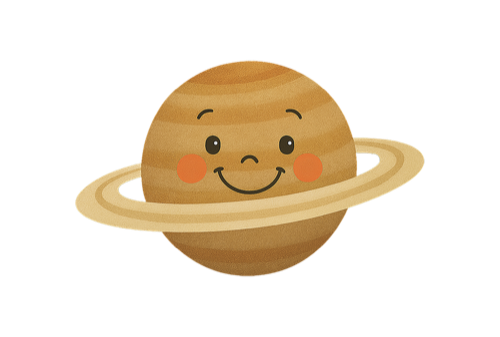
Planet
Saturn
The ringed giant so light it would float in a bath big enough to hold it
With rings made of sparkles and icy delight,
Saturn's a beauty, a shimmering sight.From Hugo's Journey Through Space
Key facts
- Diameter
- About 74,900 miles / 120,500 km at the equator (about 9 times wider than Earth)
- Distance from the Sun
- About 9.5 AU (about 891 million miles / 1,434 million km)
- One orbit
- About 29.4 Earth years (10,756 Earth days)
- One day (rotation)
- About 10.7 hours
- Average temperature
- About -140 °C at the cloud tops (134 K at the 1-bar level)
- Known moons
- 293 (as of September 2026)
- Named after
- The Roman god of agriculture and wealth, father of Jupiter
- Discovered
- Known since ancient times; first seen by telescope by Galileo in 1610
- Visited by
- Pioneer 11 (1979), Voyager 1 (1980), Voyager 2 (1981), Cassini-Huygens (in orbit 2004 to 2017)
- Rings
- Reach up to 175,000 miles / 282,000 km from the planet, but only about 10 m thick in the main rings
- Density
- 0.687 g/cm3, less dense than water
- Axial tilt
- 26.73 degrees, so Saturn has seasons
About Saturn
Saturn is a giant planet. It is made of gas. It has big, bright rings. The rings are made of ice. Some bits are like dust. Some are as big as a house. Saturn is very far from the Sun. It is very cold there. A day on Saturn is short. It lasts about ten hours. A year is very long. It takes almost thirty Earth years. Saturn has lots of moons. Titan is the biggest moon. Saturn is so light it could float. Can you see it in the sky? It looks like a bright star.
Saturn is the sixth planet from the Sun and the second largest. It is a gas giant, made mostly of hydrogen and helium. Its diameter is about 120,500 kilometres, roughly nine times wider than Earth. Saturn sits about 1.4 billion kilometres from the Sun.
One orbit around the Sun takes about 29.4 Earth years. Yet Saturn rotates very quickly, spinning once on its axis in only 10.7 hours. This fast spin makes the planet bulge around its middle. So Saturn is squashed rather than a perfect sphere.
Saturn's most famous feature is its ring system. The rings are made of countless pieces of ice and rock. The rings stretch out 282,000 kilometres from the planet. Yet in most places they are only about 10 metres thick.
Saturn is the least dense planet in the solar system. If you could find a bath big enough, Saturn would float in it. A strange six-sided storm called the hexagon sits at the north pole. It measures about 30,000 kilometres from one side to the other.
As of August 2026, Saturn has 293 known moons, more than any other planet. The largest, Titan, is bigger than the planet Mercury. The Cassini spacecraft orbited Saturn from 2004 to 2017 and sent back detailed pictures.
Saturn is the sixth planet from the Sun and the second largest in the solar system, with an equatorial diameter of about 120,500 km, roughly nine times that of Earth. It orbits at an average distance of 9.5 AU (about 1.4 billion km), taking about 29.4 Earth years (10,756 days) to complete one circuit. Its rotation is fast, one day lasting about 10.7 hours, and its axis is tilted by 26.73 degrees, so it has seasons much as Earth does. Saturn is a gas giant composed mostly of hydrogen and helium; the atmosphere is about 96 per cent hydrogen by volume. At the 1-bar pressure level the temperature is about 134 K (roughly minus 140 Celsius).
Saturn's bulk density is 0.687 g/cm3, less than that of water, which gives rise to the popular claim that it would float. In practice there is no body of water anywhere large enough, and Saturn has no solid surface to float on. Equatorial winds reach 500 metres per second, and a six-sided jet stream, the hexagon, some 30,000 km across, circles the north pole.
The rings extend up to 282,000 km from the planet yet are typically only about 10 metres thick in the main rings. They are not solid discs but countless particles of water ice, from dust to house-sized chunks, with gaps such as the 4,700 km wide Cassini Division. Saturn is not the only ringed planet; Jupiter, Uranus and Neptune have fainter rings.
As of August 2026, Saturn has 293 known moons; 128 of them were confirmed in March 2025 alone. Titan is larger than Mercury and has a thick atmosphere; Enceladus hides a global ocean beneath its icy shell.
Saturn has been known since antiquity and is named after the Roman god of agriculture and wealth, the father of Jupiter. Galileo observed it by telescope in 1610 but did not understand the rings. Pioneer 11 made the first flyby in September 1979, followed by Voyager 1 in 1980 and Voyager 2 in 1981. Cassini-Huygens, a NASA, ESA and Italian Space Agency mission, launched on 15 October 1997, entered orbit on 30 June 2004 and landed the Huygens probe on Titan on 14 January 2005. After 13 years and 22 final dives between the rings and the planet, Cassini plunged into Saturn's atmosphere on 15 September 2017.
Did you know?
- Saturn's rings reach 282,000 km out from the planet, yet in most places they are only about 10 metres thick, thinner than a house is tall.
- Saturn is so light for its size that it would float in water, if anyone could find a bath big enough.
- A six-sided storm called the hexagon sits on Saturn's north pole, about 30,000 kilometres across, with winds of about 322 kilometres per hour.
Moons of Saturn
Saturn has 293 known moons as of September 2026. The largest are listed here; the other 230 are smaller moons, most only a few kilometres across. How many moons does Saturn have?
- Titan
- Rhea
- Iapetus
- Dione
- Tethys
- Enceladus
- Mimas
- Hyperion
- Phoebe
- Janus
- Epimetheus
- Prometheus
- Pandora
- Siarnaq
- Helene
- Atlas
- Albiorix
- Pan
- Telesto
- Paaliaq
- Calypso
- Ymir
- Kiviuq
- Tarvos
- Ijiraq
- Erriapus
- Skathi
- Hyrrokkin
- Thrymr
- Daphnis
- Tarqeq
- Mundilfari
- Narvi
- Suttungr
- Bestla
- Bebhionn
- Jarnsaxa
- Eggther
- Aegir
- Alvaldi
- Kari
- Surtur
- Fornjot
- Skoll
- Greip
- Bergelmir
- Hati
- Farbauti
- Loge
- Pallene
- Gridr
- Angrboda
- Beli
- Gerd
- Gunnlod
- Skrymir
- Geirrod
- Fenrir
- Thiazzi
- Polydeuces
- Methone
- Anthe
- Aegaeon
Questions children ask
What are Saturn's rings made of?
The rings are made of countless pieces of water ice, with some dust and rock. The pieces range from tiny grains to chunks as big as a house. They are not solid; each piece orbits Saturn on its own, and there are gaps such as the 4,700 km wide Cassini Division.
Is Saturn the only planet with rings?
No. Jupiter, Uranus and Neptune have rings too, but theirs are thin and dark. Saturn's rings are much brighter and wider because they are mostly ice, so they are the only rings you can easily see through a small telescope from Earth.
Would Saturn really float in water?
Saturn's density is 0.687 g/cm3, less than water, so in theory it would float. In practice there is no ocean anywhere near big enough, and Saturn is a ball of gas with no solid surface, so it is a fun idea rather than a real test.
Has anything landed on Saturn?
No spacecraft has landed on Saturn, because it has no solid surface to land on. The Huygens probe landed on Saturn's moon Titan on 14 January 2005, and the Cassini orbiter studied Saturn for 13 years before diving into its atmosphere on 15 September 2017.
Quick quiz
Three questions for space cadets. Nothing is recorded.
- How long does one day last on Saturn?
- What are Saturn's rings mostly made of?
- Which spacecraft orbited Saturn from 2004 to 2017?
Where next?
 Jupiter
 Earth
Earth Titan
TitanSources
- https://science.nasa.gov/saturn/facts/
- https://science.nasa.gov/saturn/
- https://science.nasa.gov/saturn/moons/
- https://ssd.jpl.nasa.gov/planets/phys_par.html
- https://www.esa.int/Science_Exploration/Space_Science/Cassini-Huygens/Cassini-Huygens_factsheet
- https://science.nasa.gov/mission/cassini/
- https://science.nasa.gov/mission/cassini/grand-finale/overview/
- https://science.nasa.gov/mission/cassini/about-the-mission/
- https://en.wikipedia.org/wiki/Saturn