 Hugo's Solar System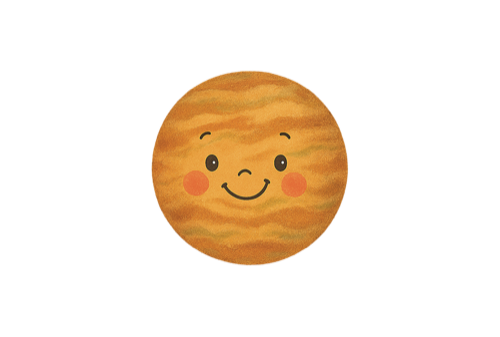
Planet
Venus
Earth's cloud-wrapped twin, and the hottest planet in the solar system
"Don't be fooled by my glow," says bright Venus with flair.
"I shimmer like diamonds but trap steamy air."From Hugo's Journey Through Space
Key facts
- Diameter
- About 7,520 miles / 12,104 km (Earth is 12,756 km)
- Distance from the Sun
- 0.72 AU (about 67.1 million miles / 108 million km)
- One orbit
- 225 Earth days
- One day (rotation)
- About 243 Earth days, spinning backwards (retrograde)
- One day-night cycle
- About 117 Earth days (sunrise to sunrise)
- Average temperature
- About 467 °C at the surface
- Surface pressure
- About 93 times Earth's sea-level pressure
- Known moons
- 0 (as of September 2026)
- Named after
- The Roman goddess of love and beauty (Aphrodite to the Greeks)
- Discovered
- Known since ancient times
- Visited by
- Mariner 2, 5 and 10, Venera landers, Pioneer Venus, Magellan, Venus Express, Akatsuki, Parker Solar Probe and others
About Venus
Venus is the second planet from the Sun. It is almost the same size as Earth. People call it Earth's twin. But Venus is very different. Thick yellow clouds cover the whole planet. The clouds trap the Sun's heat. Venus is the hottest planet of all. It is hot enough to melt lead. The air is heavy and crushing. Venus spins the wrong way round. The Sun rises in the west there. One Venus day is longer than its year. Venus has no moons at all. Look for it at dusk or dawn. It shines like a bright star.
Venus is the second planet from the Sun and Earth's closest neighbour. It is a rocky sphere about 12,104 kilometres across, slightly smaller than Earth. Because of this, people often call Venus our sister planet or twin. However, the two planets could hardly be more different.
Venus has a thick atmosphere made mostly of carbon dioxide gas. Clouds of sulphuric acid hide the surface completely from view. This heavy atmosphere traps heat, so the surface reaches about 467 degrees Celsius. That makes Venus the hottest planet, even though Mercury is closer to the Sun.
The air presses down about 93 times harder than Earth's air does. Venus orbits the Sun at about 108 million kilometres, taking 225 Earth days. It takes about 243 Earth days to rotate just once on its axis. That means a Venus day is longer than a Venus year.
Venus also rotates backwards compared with Earth and most other planets. On Venus, the Sun would rise in the west and set in the east. Beneath the clouds are volcanoes and a mountain taller than Mount Everest. Many spacecraft have flown past, orbited or landed on Venus.
The Soviet Venera landers survived for about two hours at most before failing. NASA's Magellan mapped the whole surface with radar in the early 1990s.
Venus is the second planet from the Sun and the closest planet to Earth, approaching to about 38 million km. With an equatorial diameter of about 12,104 km (Earth is 12,756 km) and a similar rocky composition, it is often called Earth's twin, but the resemblance ends at the surface. Venus orbits at an average of 108 million km (0.72 AU), completing an orbit in 225 Earth days, and rotates retrograde with a sidereal period of about 243 Earth days, so its day is longer than its year. Because of the backwards spin, a full day-night cycle on Venus, sunrise to sunrise, takes about 117 Earth days and the Sun rises in the west.
Its axis is tilted only about 3 degrees, so it has no real seasons. The atmosphere is mostly carbon dioxide beneath global clouds of sulphuric acid. It produces a runaway greenhouse effect that holds the surface at about 467 °C, making Venus, not Mercury, the hottest planet in the solar system, with a surface pressure about 93 times Earth's sea-level pressure. Winds at the cloud tops reach about 360 km/h, circling the planet far faster than it rotates.
Radar mapping reveals volcanoes, lava plains, pancake-shaped domes up to 62 km wide and a mountain about 11 km high, taller than Everest. The surface appears geologically young, with some regions perhaps only 150 million years old. Venus has no moons. It does have a quasi-satellite, the asteroid Zoozve (discovered 11 November 2002), which loops around Venus while orbiting the Sun.
Exploration began with NASA's Mariner 2 flyby on 14 December 1962, the first successful visit to another planet. Soviet Venera and Vega probes put ten landers on the surface between 1970 and 1985; the longest-lived, Venera 13, survived for about two hours. Mariner 5 and Mariner 10 flew past, Pioneer Venus 1 orbited from 1978 and Pioneer Venus 2 dropped atmospheric probes. Magellan (launched 1989) radar-mapped almost the entire surface before its mission ended in 1994.
Galileo, Cassini, MESSENGER, BepiColombo and Parker Solar Probe (final Venus flyby 6 November 2024) have used Venus for gravity assists and science. ESA's Venus Express orbited from 2006 and Japan's Akatsuki, launched in 2010, has studied the atmosphere. NASA's DAVINCI and VERITAS and ESA's EnVision (planned for the 2030s) are the next missions. Venus is named after the Roman goddess of love and beauty and has been known since antiquity.
Did you know?
- A day on Venus lasts about 243 Earth days, but its year lasts only 225, so a Venus day is longer than a Venus year.
- Venus spins backwards, so if you could see through its clouds the Sun would rise in the west and set in the east.
- Venus is hotter than Mercury even though it is further from the Sun, because its thick carbon dioxide air traps the heat.
Moons of Venus
Venus has no moons.
Questions children ask
Why is Venus hotter than Mercury?
Mercury is closer to the Sun, but it has almost no air to hold on to heat. Venus has a very thick atmosphere of carbon dioxide that traps the Sun's warmth like a blanket, keeping the surface at about 467 °C all the time.
Can I see Venus from my garden?
Yes. Venus is the brightest planet in our sky and is easy to spot without a telescope. Look low in the west after sunset or low in the east before sunrise, which is why people call it the evening star or morning star.
Has anyone landed on Venus?
No people have, but robots have. Between 1970 and 1985 Soviet Venera and Vega probes landed ten times on the surface. They sent back the first pictures, but the heat and crushing pressure destroyed them within about two hours.
Does Venus have any moons?
No. Venus has no moons at all, as of August 2026. It does have a small asteroid called Zoozve, found in 2002, that seems to loop around Venus while really orbiting the Sun. Astronomers call it a quasi-satellite.
Quick quiz
Three questions for space cadets. Nothing is recorded.
- Which planet is the hottest in the solar system?
- What is strange about the way Venus spins?
- How many moons does Venus have?
 Earth
Earth Mercury
 Mars
Mars