 Hugo's Solar System
Home › Explore › Interstellar Space
Region
Interstellar Space
The thin, cold space between the stars, where the Voyagers fly on and the Sun's gravity still reaches
Key facts
- Where it begins
- Beyond the heliopause, about 120 AU from the Sun
- What it is made of
- Very thin gas, mostly hydrogen and helium, plus dust: about one atom in every ten cubic centimetres
- Temperature
- The gas near the Sun's bubble is a few thousand degrees, but so thin it would feel like nothing
- Who is there
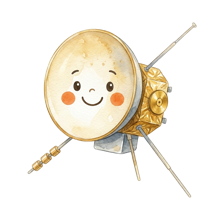
- Voyager 1 (since 2012) and Voyager 2 (since 2018), still sending data home
- The Sun's motion
- The Sun and planets move through it at about 26 km per second
- Still bound to the Sun
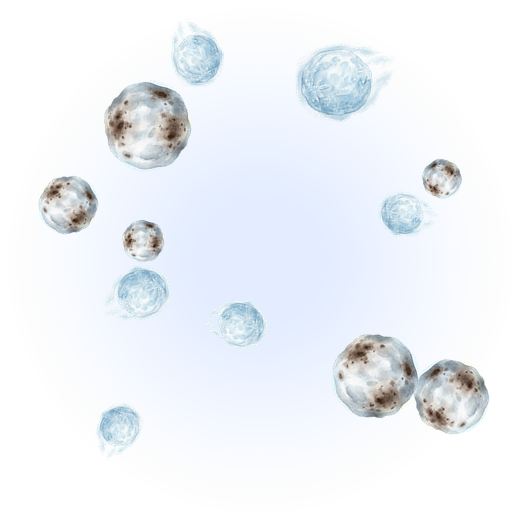
- Yes. The Oort cloud, from 2,000 to 100,000 AU, is out here and still orbits the Sun
- Nearest star
- Proxima Centauri, about 268,000 AU away; Voyager would need about 70,000 years to travel that far
About Interstellar Space
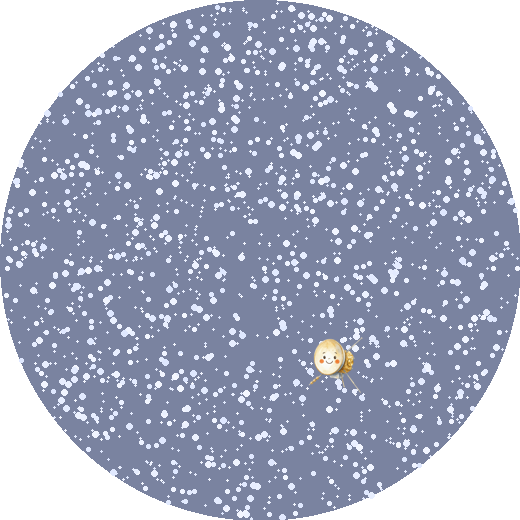
Past the edge of the Sun's bubble is the space between the stars. It is very dark, very cold and very empty. Two robot spacecraft, Voyager 1 and Voyager 2, are out here now, still sending messages home. Far, far beyond them is a giant cloud of icy comets called the Oort cloud. The Sun still holds all of that with its gravity, so Hugo's journey carries on to the Oort cloud.
Interstellar space is the region between the stars, filled with an extremely thin mix of gas and dust called the interstellar medium. Beyond the heliopause the Sun's wind no longer pushes it away, so Voyager 1 and Voyager 2 are now flying through it, still sending data home from more than 140 times farther from the Sun than Earth. It is not empty of the Sun's influence, though: the Sun's gravity still holds the Oort cloud, a thousand times farther out, and no spacecraft will leave that for tens of thousands of years.
The local interstellar medium near the Sun is a warm, partly ionised cloud with about 0.1 atoms per cubic centimetre, mostly hydrogen and helium, laced with dust and a magnetic field of a few microgauss. The Sun is moving through it at about 26 km per second, which compresses the heliosphere on the upwind side. Voyager 1 entered it in August 2012 and Voyager 2 in November 2018; both continue to return plasma, magnetic field and cosmic ray measurements, though NASA has been switching instruments off to conserve their fading plutonium power. Gravitationally the solar system extends far beyond: the Oort cloud, at 2,000 to 100,000 AU, remains bound to the Sun, and Voyager 1 will take about 300 years to reach its inner edge.
Did you know?
- Interstellar space is so empty that a shoebox of it holds only a few hundred atoms.
- The Voyagers carry Golden Records with music, greetings and pictures of Earth for anyone who might find them.
- In about 40,000 years Voyager 1 will drift within 1.6 light-years of a star called Gliese 445.
Questions children ask
Have the Voyagers left the solar system?
They have left the heliosphere, the Sun's bubble of wind, so they are in interstellar space. But the Sun's gravity still holds them and the Oort cloud beyond, so by that definition they are still inside the solar system.
What is out here?
Mostly nothing: a very thin gas of hydrogen and helium, tiny dust grains, magnetic fields and cosmic rays. Very far out, the icy bodies of the Oort cloud.
Is this the end of the solar system?
No. The Sun's wind stops at the heliopause, but the Sun's gravity keeps hold of everything out to the Oort cloud, a thousand times farther. That is where Hugo's journey ends.
Quick quiz
Three questions for space cadets. Nothing is recorded.
- Where does interstellar space begin?
- Which spacecraft are in interstellar space now?
- What still holds the Oort cloud in place out here?
 The Heliopause
 Voyager 1
 The Oort Cloud