 Hugo's Solar System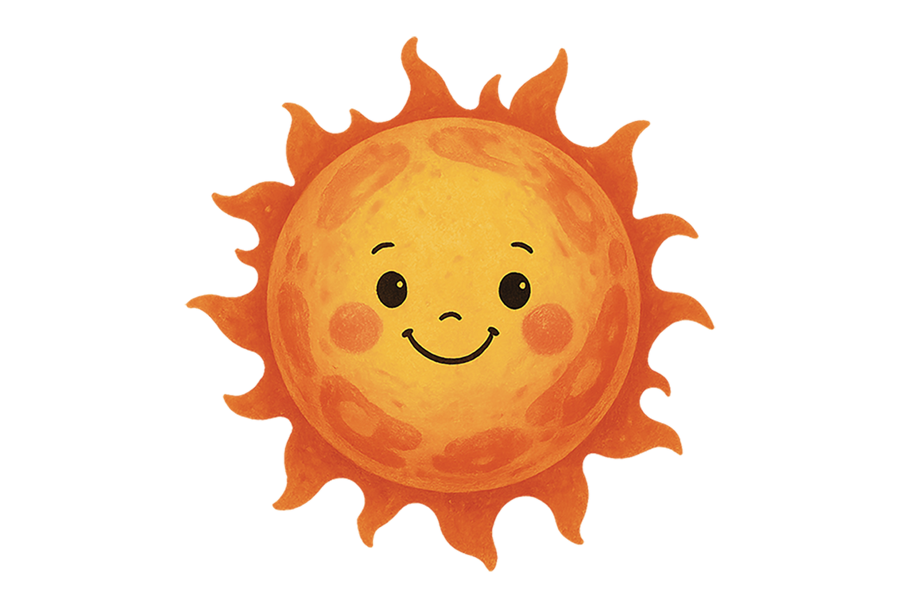
Star
The Sun
Our nearest star, a giant ball of glowing gas that gives Earth its light and warmth
"Hotter than hot," says the Sun with a grin.
Its golden flames dancing and warming his skin.From Hugo's Journey Through Space
Key facts
- Diameter
- About 0.87 million miles / 1.4 million km (about 109 times wider than Earth)
- Mass
- About 333,000 Earths, or 99.8% of the whole solar system
- Age
- About 4.5 billion years
- Surface temperature
- About 5,500 °C (the photosphere)
- Core temperature
- About 15 million °C
- Distance from Earth
- About 93.2 million miles / 150 million km (1 au)
- Light travel time
- About 8 minutes 19 seconds to reach Earth
- Type of star
- G2 V yellow dwarf, a main-sequence star
- One rotation
- About 25 days at the equator, about 36 days near the poles
- Known moons
- None (as of August 2026); stars do not have moons
- Studied by
- Parker Solar Probe, Solar Orbiter, SOHO, SDO, STEREO, Hinode, IRIS and Wind
About The Sun
The Sun is a star. It is our closest star. It is a giant ball of hot gas. It has no hard ground to stand on. The Sun is very, very big. A million Earths could fit inside it. Its light and warmth reach us here. That light takes eight minutes to arrive. Plants use sunlight to grow. Earth goes round the Sun once a year. Never look straight at the Sun. It can hurt your eyes.
The Sun is the star at the centre of our solar system. It is a huge sphere of hot gas, mostly hydrogen and helium. Its own gravity squeezes it together and keeps it round. The Sun is about 1.4 million kilometres across.
That makes it about 100 times wider than Earth. Around 1.3 million Earths could fit inside its volume. Deep in the core, the temperature reaches about 15 million degrees Celsius. There, hydrogen atoms join together to make helium and release enormous energy.
That energy travels out as light and heat across space. Sunlight takes about eight minutes to reach Earth. The Sun's surface is far cooler than the core, at about 5,500 degrees Celsius. Its outer atmosphere, called the corona, is strangely much hotter again.
The Sun is not solid, so different parts rotate at different speeds. The equator spins once in about 25 days, the poles in about 36. Every planet, including Earth, follows an orbit around the Sun because of its gravity. The Sun is about 4.5 billion years old and roughly halfway through its life.
Spacecraft such as Parker Solar Probe study the Sun from very close up. It flies within about 6.2 million kilometres of the Sun.
The Sun is a G2 V main-sequence star, commonly called a yellow dwarf, and the only star in our solar system. It formed about 4.5 billion years ago and should keep fusing hydrogen for roughly another 5 billion years before swelling into a red giant and finally settling into a white dwarf. By mass it is roughly three-quarters hydrogen and one-quarter helium, with traces of heavier elements. Its diameter is about 1.4 million km, roughly 109 times Earth's, and it holds about 99.8% of the solar system's mass, some 333,000 Earth masses. Around 1.3 million Earths would fill its volume.
The Sun has no solid surface; it is a ball of plasma held together by its own gravity. In the core, at about 15 million °C, hydrogen nuclei fuse into helium. This is nuclear fusion, not burning in any chemical sense. Energy takes about 170,000 years to work its way out through the radiative zone, then rises through the convection zone to the photosphere, the visible surface, which is a comparatively cool 5,500 °C. Above it lie the chromosphere and the corona, which is puzzlingly hot at up to 2 million °C. Material streaming away from the corona becomes the solar wind. Because it is not solid, the Sun rotates differentially: once in about 25 days at the equator and about 36 days near the poles. Its magnetic poles flip roughly every 11 years, driving the sunspot cycle.
Earth orbits at an average of about 150 million km (1 au), so sunlight takes about 8 minutes 19 seconds to reach us. The Sun itself orbits the centre of the Milky Way about once every 230 million years. Despite a common classroom claim, it is not an unusually large star; by galactic standards it is fairly average.
Missions studying the Sun include NASA's Parker Solar Probe, launched on 12 August 2018, which on 14 December 2021 became the first spacecraft to fly through the corona and now passes within about 6.2 million km of the Sun at about 700,000 km/h; the ESA-led Solar Orbiter, launched in February 2020, which approaches to about 42 million km and has returned the first close-up images of the Sun's poles; and the long-serving SOHO, SDO, STEREO, Hinode, IRIS and Wind observatories. A safety note for classrooms: never look directly at the Sun, even during an eclipse, without certified solar filters.
Did you know?
- Energy made in the Sun's core takes about 170,000 years to reach the surface, then only about eight minutes to reach Earth.
- The Sun's outer atmosphere, the corona, is far hotter than its surface, reaching about 2 million °C. Scientists are still working out why.
- On 14 December 2021, NASA's Parker Solar Probe flew through the corona and became the first spacecraft ever to touch the Sun.
Questions children ask
Is the Sun on fire?
No. Nothing is burning. Deep in the core, at about 15 million °C, hydrogen is squeezed so hard that it fuses into helium. This nuclear fusion releases the energy that becomes sunlight. It has kept the Sun shining for about 4.5 billion years.
How big is the Sun compared with Earth?
Enormous. The Sun is about 1.4 million km across, roughly 109 times wider than Earth. About 1.3 million Earths could fit inside it, and it holds about 99.8% of all the mass in the solar system.
Could a spacecraft ever land on the Sun?
No. The Sun has no solid surface to land on; it is a ball of hot plasma. The closest any spacecraft has come is NASA's Parker Solar Probe, which flies within about 6.2 million km behind a thick heat shield.
Will the Sun ever go out?
Not for a very long time. The Sun is about halfway through its life and should shine steadily for roughly another 5 billion years. Eventually it will swell into a red giant and then shrink into a small, faint white dwarf.
Quick quiz
Three questions for space cadets. Nothing is recorded.
- What is the Sun mostly made of?
- About how long does sunlight take to reach Earth?
- Which spacecraft was the first to fly through the Sun's corona?
Where next?
 Earth
Earth Jupiter
Sources
- https://science.nasa.gov/sun/facts/
- https://science.nasa.gov/sun/
- https://science.nasa.gov/mission/parker-solar-probe/
- https://www.esa.int/Science_Exploration/Space_Science/Solar_Orbiter
- https://solar-center.stanford.edu/vitalstats.html
- https://spaceplace.nasa.gov/all-about-the-sun/en/
- https://en.wikipedia.org/wiki/Sun