 Hugo's Solar System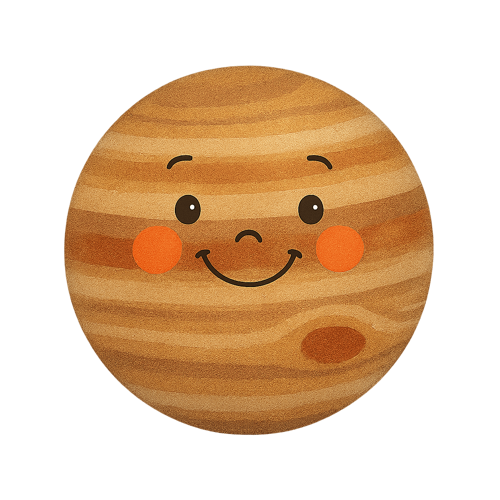
Planet
Jupiter
The king of the planets, a striped gas giant with a storm twice as wide as Earth
"Booming and swirling," roars Jupiter loud,
A stripy old giant wrapped up in a cloud.From Hugo's Journey Through Space
Key facts
- Diameter
- About 86,900 miles / 139,820 km (mean); about 142,980 km at the equator, 11 times wider than Earth
- Distance from the Sun
- 5.2 AU (483 million miles / 778 million km)
- One orbit
- 11.86 Earth years (4,333 Earth days)
- One day (rotation)
- About 9.9 hours, the shortest day of any planet
- Average temperature
- About -108 °C at the 1-bar cloud level
- Known moons
- 115 (as of September 2026)
- Mass
- About 318 Earths, more than twice all the other planets combined
- Named after
- Jupiter, king of the ancient Roman gods
- Discovered
- Known since ancient times; its four largest moons were found by Galileo in 1610
- Rings
- Thin and dark; discovered in 1979 by Voyager 1
- Visited by
- Pioneer 10 and 11, Voyager 1 and 2, Ulysses, Galileo, Cassini, New Horizons and Juno; Europa Clipper and JUICE are on their way
About Jupiter
Jupiter is the biggest planet of all. It is a giant ball of gas. You could not stand on it. Its clouds make stripes of red and cream. A huge red storm swirls on Jupiter. The storm is wider than Earth. It has raged for hundreds of years. Jupiter spins very fast. One day lasts only ten hours. It has more than a hundred moons. Four of them are very big. You can see Jupiter at night. It shines like a bright star.
Jupiter is the largest planet in our solar system by a long way. It is a gas giant, made mostly of hydrogen and helium. Its radius is about 69,911 kilometres, which makes it 11 times wider than Earth. If Earth were a grape, Jupiter would be a basketball.
Jupiter has no solid surface, so a spacecraft could never land there. Its atmosphere is full of cold, windy clouds of ammonia and water. Winds near the equator can blow at 539 kilometres per hour. Its most famous feature is the Great Red Spot, a giant storm.
That storm is twice as wide as Earth. People have watched it for more than 300 years. Jupiter rotates faster than any other planet, so a day lasts only 9.9 hours. This fast spin makes the planet bulge slightly at its equator.
One orbit around the Sun takes about 12 Earth years. Jupiter sits about 778 million kilometres from the Sun. Its strong gravity holds on to 115 known moons, as of August 2026. The four biggest are Io, Europa, Ganymede and Callisto.
Galileo spotted them with his telescope in 1610. NASA's Juno spacecraft entered orbit around Jupiter in 2016.
Jupiter is the fifth planet from the Sun and by far the largest in the solar system, with more than twice the mass of all the other planets combined (about 318 Earth masses). Its mean radius is 69,911 km, roughly 11 times that of Earth, and it orbits at an average distance of 5.2 AU (778 million km), taking 11.86 Earth years (4,333 days) to complete one circuit. It rotates in about 9.9 hours, the shortest day of any planet, and its axis is tilted by only 3 degrees, so it has no real seasons.
Jupiter is a gas giant composed mostly of hydrogen and helium, with the same basic ingredients as a star but far too little mass to ignite fusion. There is no solid surface: the visible bands are cloud decks of ammonia and water spanning about 71 km in depth, driven by winds of up to 539 km/h at the equator. The mean temperature at the 1-bar pressure level is about -108 °C. The Great Red Spot is an anticyclonic storm twice as wide as Earth; it has been watched for more than 300 years and continuously since 1831, and Juno gravity data show its roots extend roughly 300 to 500 km below the cloud tops. Jupiter's magnetic field is 16 to 54 times stronger than Earth's and powers auroras hundreds of times more energetic than ours.
A thin, dark ring system was discovered by Voyager 1 in 1979. As of August 2026 Jupiter has 115 known moons, the four largest, Io, Europa, Ganymede and Callisto, having been discovered by Galileo Galilei in 1610. The planet itself has been known since antiquity and is named after the king of the Roman gods.
Nine spacecraft have reached Jupiter: Pioneer 10 (closest approach 4 December 1973), Pioneer 11 (1974), Voyager 1 and Voyager 2 (1979), Ulysses (8 February 1992), the Galileo orbiter (1995 to 2003, including an atmospheric probe), Cassini (October 2000 to March 2001 en route to Saturn), New Horizons (28 February 2007) and Juno, which entered orbit on 4 July 2016 and whose extended mission was planned to run until September 2025. Two more are on their way: ESA's JUICE, launched 14 April 2023 and due to arrive in July 2031, and NASA's Europa Clipper, launched 14 October 2024 and due in 2030.
Did you know?
- Jupiter has the same ingredients as a star, hydrogen and helium, but it never grew massive enough to ignite and shine.
- Sunlight takes about 43 minutes to reach Jupiter, compared with about 8 minutes to reach Earth.
- Jupiter's magnetic field is up to 54 times stronger than Earth's and stretches millions of kilometres towards the Sun.
Moons of Jupiter
Jupiter has 115 known moons as of September 2026. The largest are listed here; the other 58 are smaller moons, most only a few kilometres across. How many moons does Jupiter have?
- Ganymede
- Callisto
- Io
- Europa
- Amalthea
- Himalia
- Thebe
- Elara
- Pasiphae
- Carme
- Metis
- Sinope
- Lysithea
- Ananke
- Leda
- Adrastea
- Callirrhoe
- Themisto
- Praxidike
- Kalyke
- Megaclite
- Taygete
- Iocaste
- Chaldene
- Harpalyke
- Isonoe
- Autonoe
- Thyone
- Hermippe
- Aoede
- Helike
- Eukelade
- Dia
- Eirene
- Erinome
- Aitne
- Eurydome
- Euanthe
- Hegemone
- Arche
- Carpo
- Pandia
- Ersa
- Euporie
- Orthosie
- Sponde
- Kale
- Pasithee
- Mneme
- Thelxinoe
- Kallichore
- Cyllene
- Kore
- Herse
- Philophrosyne
- Eupheme
- Valetudo
Questions children ask
Could I stand on Jupiter?
No. Jupiter is a gas giant with no solid ground to stand on. If you fell into its clouds you would just keep sinking as the gas grew thicker, hotter and more crushing the deeper you went. Spacecraft can orbit Jupiter, but nothing can land on it.
What is the Great Red Spot?
It is a gigantic storm in Jupiter's atmosphere, about twice as wide as Earth. Astronomers have watched it for more than 300 years, continuously since 1831. Its roots reach hundreds of kilometres down below the cloud tops, and it has been slowly shrinking in recent decades.
How many moons does Jupiter have?
As of August 2026, Jupiter has 115 known moons. Most are small rocks only a few kilometres across. The four largest, Io, Europa, Ganymede and Callisto, were discovered by Galileo in 1610 and can be seen with a small telescope or good binoculars.
Which spacecraft have gone to Jupiter recently?
NASA's Juno spacecraft entered orbit around Jupiter on 4 July 2016 to study its clouds, magnetic field and interior; its extended mission was planned to run until September 2025. Two more are travelling there: NASA's Europa Clipper, due in 2030, and ESA's JUICE, due in July 2031, both to study the planet's icy ocean moons.
Quick quiz
Three questions for space cadets. Nothing is recorded.
- How long is one day on Jupiter?
- What is Jupiter mostly made of?
- Which spacecraft discovered Jupiter's rings in 1979?
Where next?
 Saturn
 Earth
Earth The Sun
Sources
- https://science.nasa.gov/jupiter/facts/
- https://science.nasa.gov/jupiter/
- https://science.nasa.gov/jupiter/exploration/
- https://science.nasa.gov/mission/juno/
- https://science.nasa.gov/mission/new-horizons/
- https://science.nasa.gov/mission/ulysses/
- https://ssd.jpl.nasa.gov/planets/phys_par.html
- https://ssd.jpl.nasa.gov/sats/elem/
- https://www.esa.int/Science_Exploration/Space_Science/Juice
- https://spaceplace.nasa.gov/all-about-jupiter/en/
- https://en.wikipedia.org/wiki/Jupiter