 Hugo's Solar System
Home › Explore › The Asteroid Belt
Region
The Asteroid Belt
A wide ring of rocky leftovers between Mars and Jupiter, with Ceres as its biggest resident
Key facts
- Where it is
- Between the orbits of Mars and Jupiter, about 2.2 to 3.2 AU from the Sun
- Width
- Roughly 93.2 million miles / 150 million km from inner edge to outer edge
- How many
- More than 1 million asteroids wider than 0.62 miles / 1 km, plus many millions of smaller ones
- Biggest member
- Ceres, about 583 miles / 939 km across, a dwarf planet holding roughly a quarter of the belt's mass
- Next biggest
- Vesta (about 326 miles / 525 km), Pallas (about 512 km) and Hygiea (about 430 km)
- Total mass
- About 3 percent of the mass of our Moon, spread across the whole ring
- Typical spacing
- Neighbouring asteroids are usually about 0.62 million miles / 1 million km apart
- First discovered
- Ceres, on 1 January 1801, by Giuseppe Piazzi
- Visited by
- NASA's Dawn (Vesta 2011 to 2012, Ceres 2015 to 2018); many probes have crossed it safely
- Why no planet formed
- Jupiter's gravity stirred the rocks so they smashed apart instead of sticking together
About The Asteroid Belt
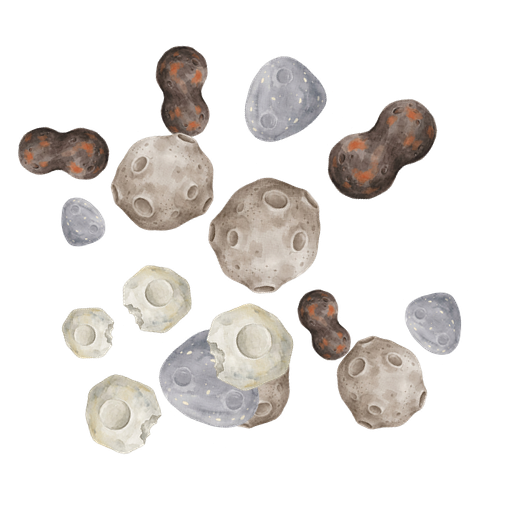
Between Mars and Jupiter there is a big ring of rocks called the asteroid belt. Some rocks are as small as a house. Some are as big as a mountain. The biggest one is Ceres, and it is round like a little planet. The rocks are very far apart, so Hugo can fly through without bumping into any.
The asteroid belt is a wide ring of rocky bodies between the orbits of Mars and Jupiter, about 2.2 to 3.2 times as far from the Sun as Earth. Astronomers know of more than a million asteroids bigger than a kilometre across, and Ceres, a dwarf planet, holds about a quarter of the whole belt's mass. Films show asteroids crowded together, but in real life they are usually hundreds of thousands of kilometres apart. Spacecraft such as Voyager, Galileo and Dawn have crossed the belt without trouble.
The main asteroid belt occupies the region between roughly 2.2 and 3.2 AU, where Jupiter's gravity prevented the planetesimals of the early solar system from gathering into a planet. Its total mass is only about 3 percent of the Moon's, and Ceres alone accounts for roughly a quarter to a third of it; Vesta, Pallas and Hygiea make up much of the rest. Orbital resonances with Jupiter carve near-empty lanes, the Kirkwood gaps, at 2.5 and 2.82 AU. NASA's Dawn mission orbited Vesta in 2011 and 2012 and Ceres from 2015 to 2018, and the belt is thought to be the source of most meteorites that reach Earth.
Did you know?
- If you gathered every asteroid in the belt into one ball, it would still be far smaller than our Moon.
- The Kirkwood gaps are empty lanes in the belt where Jupiter's pull has swept the rocks away.
- Most meteorites that land on Earth are chips knocked off asteroids in the belt.
Questions children ask
Is it dangerous to fly through the asteroid belt?
No. The asteroids are so spread out that a spacecraft crossing the belt is very unlikely to pass close to one. Pioneer 10, both Voyagers, Galileo, Cassini, New Horizons and Juno have all crossed it without a problem.
Why is there a belt instead of a planet?
When the solar system was forming, Jupiter's gravity kept stirring up the rocks in this region. They collided too fast to stick together, so they never grew into a planet.
Are all asteroids in the belt?
No. Most are, but some share Jupiter's orbit (the Trojans) and some cross Earth's orbit (near-Earth asteroids). Ceres is the only dwarf planet in the belt.
What are asteroids made of?
Mostly rock and metal. Dark carbon-rich ones are the most common, brighter stony ones sit nearer the inner edge, and a few are almost solid iron and nickel.
Quick quiz
Three questions for space cadets. Nothing is recorded.
- Where is the asteroid belt?
- What is the biggest object in the asteroid belt?
- How far apart are neighbouring asteroids, usually?
 Ceres
Ceres Mars
Mars Jupiter