 Hugo's Solar System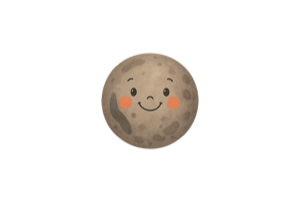
Dwarf planet
Ceres
The round little world hiding in the asteroid belt, with salty white spots
Nestled in space where the asteroids roam,
Ceres feels cosy, like she's found a home.From Hugo's Journey Through Space
Key facts
- Diameter
- About 583 miles / 939 km (radius 476 km, about 1/13 of Earth's)
- Distance from the Sun
- 2.8 AU, about 257 million miles / 413 million km on average
- One orbit
- 1,682 Earth days, about 4.6 Earth years
- One day (rotation)
- About 9 hours 4 minutes
- Average temperature
- Very cold: roughly -160 °C to -40 °C across the surface
- Known moons
- 0 (as of September 2026)
- Named after
- Ceres, the Roman goddess of agriculture and harvests
- Discovered
- 1 January 1801, by Giuseppe Piazzi in Palermo, Sicily
- Visited by
- NASA's Dawn spacecraft, in orbit from 6 March 2015 to 1 November 2018
- Type
- Dwarf planet, the largest object in the asteroid belt
- Sunlight travel time
- About 22 minutes from the Sun
About Ceres
Ceres is a small round world. It lives between Mars and Jupiter. Lots of rocks float there too. Ceres is the biggest of them all. It is a dwarf planet. That means it is small and round. Ceres is made of rock and ice. It has bright white spots. They are made of salt. A spacecraft called Dawn went there. Dawn flew round and round Ceres. It took lots of photos. One day you might see them. Ceres has no moons at all.
Ceres is the largest object in the asteroid belt between Mars and Jupiter. It is about 940 km across, roughly a quarter the width of the Moon. That is big enough for its own gravity to pull it into a sphere. This is why scientists call Ceres a dwarf planet, not an asteroid.
Ceres takes about 4.6 Earth years to orbit the Sun once. It sits about 2.8 astronomical units from the Sun, or 413 million km. Sunlight takes about 22 minutes to reach it. Ceres rotates quickly, spinning once every 9 hours on its axis.
Its surface is a dark mix of rock, ice and clay. In some craters there are bright white patches of salt. The brightest patches are in a crater called Occator. Scientists think salty water once seeped up from below and dried out.
A lonely mountain called Ahuna Mons rises about 5 km above the surface. Ceres may hold as much as 25 per cent water inside it. NASA's Dawn spacecraft orbited Ceres from 2015 until 2018. It was the first spacecraft ever to orbit a dwarf planet.
An astronomer named Giuseppe Piazzi discovered Ceres on 1 January 1801. As of August 2026, Ceres has no known moons.
Ceres is the largest body in the main asteroid belt and the only dwarf planet in the inner solar system. With a mean diameter of about 939 km (NASA gives a radius of 476 km, roughly one-thirteenth of Earth's), it holds about a quarter of the belt's total mass, yet Pluto is still around 14 times more massive. It orbits the Sun at an average of 2.8 AU (about 413 million km), completing one orbit every 1,682 Earth days, or 4.6 years, and rotates once every 9 hours 4 minutes with an axial tilt of only 4 degrees. JPL gives its density as 2.16 g/cm³, consistent with a mix of rock and ice; NASA suggests Ceres could be as much as 25 per cent water. Surface temperatures range from roughly minus 160 °C to about minus 40 °C.
Giuseppe Piazzi discovered Ceres from Palermo on 1 January 1801 and it was initially counted as a planet. As more bodies turned up in the same region it was reclassified as an asteroid in the 1860s, and in 2006 the International Astronomical Union made it a dwarf planet. It is named after the Roman goddess of agriculture and harvests, which is also the origin of the word cereal.
In January 2014 ESA's Herschel space observatory detected water vapour escaping from two localised spots on Ceres at roughly 6 kg per second, the first clear detection of water vapour from a body in the asteroid belt. NASA's Dawn spacecraft, launched on 27 September 2007, orbited the asteroid Vesta from July 2011 to September 2012 and then entered orbit around Ceres on 6 March 2015, making Ceres the first dwarf planet ever visited. Dawn mapped the whole surface, found the bright deposits in Occator Crater to be mainly sodium carbonate, evidence of brine that rose from below and evaporated, and imaged Ahuna Mons, a solitary mountain about 5 km high that is probably a cryovolcano. The mission ended on 1 November 2018 when Dawn exhausted its hydrazine fuel; it remains in a stable orbit around Ceres. No moons or rings have been found; as of August 2026 Ceres has no known moons.
A common mix-up is worth correcting: Ceres is not in the Kuiper Belt with Pluto, Haumea, Makemake and Eris. It lies between Mars and Jupiter, far closer to the Sun than any other dwarf planet.
Did you know?
- When Piazzi found Ceres in 1801 it was called a planet. It was demoted to an asteroid, then promoted to a dwarf planet in 2006.
- The bright white spots in Occator Crater are mostly sodium carbonate, a kind of salt left behind when salty water dried out.
- The word cereal comes from Ceres, the Roman goddess of harvests that the dwarf planet is named after.
Moons of Ceres
Ceres has no moons.
Questions children ask
Is Ceres a planet or an asteroid?
It is a dwarf planet. Ceres is round because its own gravity has pulled it into a sphere, but it has not cleared the other rocks out of its orbit. It is still the biggest object in the asteroid belt, holding about a quarter of the belt's mass.
What are the bright spots on Ceres?
They are patches of salt, mainly sodium carbonate, sitting in craters such as Occator. Scientists think salty water rose up from under the surface, then evaporated and left the salt behind, a bit like the white rings a dried puddle leaves.
Has anyone been to Ceres?
No people, but NASA's Dawn spacecraft orbited Ceres from March 2015 until November 2018. It was the first spacecraft ever to orbit a dwarf planet. Dawn ran out of fuel and is still circling Ceres silently today.
Is there water on Ceres?
Yes. Ceres may be as much as a quarter water, mostly frozen as ice under a rocky crust. In 2014 the Herschel space telescope even spotted water vapour puffing off its surface at about 6 kg every second.
Quick quiz
Three questions for space cadets. Nothing is recorded.
- Where in the solar system is Ceres?
- Which spacecraft orbited Ceres from 2015 to 2018?
- What makes the bright spots in Occator Crater shine?
Where next?
 Pluto
Pluto The Moon
 Mars
MarsSources
- https://science.nasa.gov/dwarf-planets/ceres/facts/
- https://science.nasa.gov/dwarf-planets/ceres/
- https://science.nasa.gov/dwarf-planets/ceres/exploration/
- https://science.nasa.gov/mission/dawn/
- https://ssd-api.jpl.nasa.gov/sbdb.api?sstr=1&phys-par=1
- https://www.esa.int/Science_Exploration/Space_Science/Herschel/Herschel_discovers_water_vapour_around_dwarf_planet_Ceres
- https://en.wikipedia.org/wiki/Ceres_(dwarf_planet)
- https://en.wikipedia.org/wiki/Dawn_(spacecraft)